


 Language: English

















Solutions
Horse Construction offers full range of structural strengthening materials with technical supports, documentation supports, products supports, project supports.
Rebar Was Cut for an Opening in Column? How to Repair It Properly

Why a Cut Bar in a Column Is a Different Order of Problem
Service openings get cut into columns for pipes, drains, and cables far more often than they should. In a slab, a cut bar is a local defect. In a column, it is a threat to the vertical load path of the entire building.
Cut into a column and three separate capacities are damaged at once:
Longitudinal bars severed → axial and flexural capacity lost directly. The column's compression and bending resistance comes from those bars working with the concrete. Severed bars mean the load that section was carrying has nowhere to go but into the remaining concrete and neighboring bars.
Ties (stirrups) severed → shear capacity, confinement, and ductility lost. The ties are what hold the core together, resist shear, and keep the column from failing in a brittle manner. A column with cut ties is a column that has lost its safety net.
The section itself is reduced. An opening removes concrete and interrupts the stress flow, concentrating stresses at the hole edges — exactly where cracking starts and where no reinforcement now exists.
And the stakes are categorically higher than in a slab. A damaged slab redistributes load; a damaged column can trigger progressive collapse. In seismic regions the situation is worse still: columns are the primary lateral-force elements, and cutting ties in the confinement zone at a column end removes precisely the mechanism that keeps the column ductile under earthquake loading.
This is why structural codes treat openings in columns far more strictly than openings in slabs — and why a column opening is not a finish-it-later item. It is a repair-it-now item.
Filling the hole with mortar and skimming it over does not repair any of this. It hides the problem on the one element you can least afford to hide problems on.
The Correct Repair Sequence
Repairing a cut-bar opening in a column means restoring the bar, restoring the concrete, and then adding margin. The sequence matters as much as the steps.

Step 1 — Expose and assess the cut bars
Chip back the concrete around the opening until the full cross-section of every severed bar is exposed on both sides — longitudinal bars and ties alike — with enough clean, sound concrete behind them to develop a splice. Record the bar diameter, spacing, and grade: the replacement must match the original, not approximate it.
Before cutting anything further, confirm where the opening sits relative to the column's critical zones. Openings near column ends, in the confinement (hinge) region, or interrupting a high proportion of the section are a design question, not a repair question — they need engineering assessment before work starts.


Step 2 — Restore the bar with an equal-area splice
Two short bars of equal cross-sectional area to the original are lapped onto the cut ends — one on each side — restoring continuity across the opening. This applies to both the longitudinal bars and the severed ties; a repaired column with restored main bars but open ties is still a compromised column.
For steel bars: a welded lap splice, executed to a qualified welding procedure by a certified welder. Weld quality is not a detail here; a poor weld turns the splice into a crack starter.
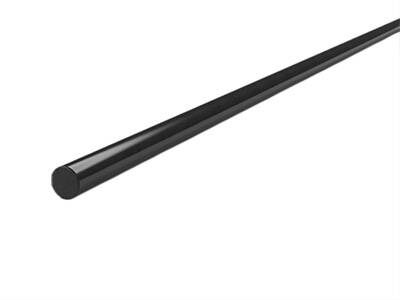
For carbon fiber rebar: carbon rebar cannot be welded. It is connected by adhesive-bonded laps or mechanical anchors designed for the purpose — a point worth stating plainly, because substituting carbon rebar into a welding detail is a common and serious error.
Where welding is impractical in a congested or damp location, mechanical couplers are an accepted alternative — the requirement is a full-strength, verifiable connection, not a particular technique.

Step 3 — Form the opening with a pouring funnel
Reinstate formwork on the sides and underside of the opening, and leave a funnel (trumpet-shaped pour chute) at the top. The funnel is not a convenience: it provides the head pressure and free surface that let grout flow into every corner of the void, around the new splice bars, and out through the top — without air pockets or voids forming under the repair.


Step 4 — Pour non-shrink grout
Fill the formed void with a non-shrink, flowable grout (to ASTM C1107 or equivalent), placed continuously from one side so the material rises through the opening rather than trapping air. Shrinkage is the enemy of this repair: a grout that shrinks pulls away from the old concrete and the splice bars, and the interface that was supposed to transfer load becomes a gap. Non-shrink grout, properly cured, restores monolithic behavior — the repaired section behaves as one.


Step 5 — Cure, strip, and finish
Cure to the grout manufacturer's specification, then strip the formwork and cut back the surplus material from the funnel flush with the concrete surface. What remains should be indistinguishable in section from the original column.

Step 6 — Add circumferential CFRP confinement
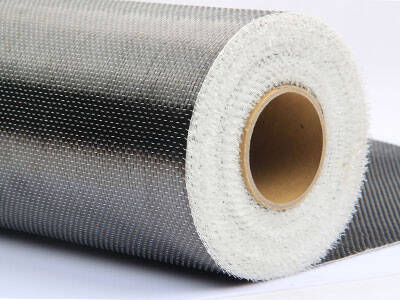
The repair above restores the bar and the section. The recommended final step restores margin: wrapping the opening region with circumferential CFRP fabric — a closed-loop composite band around the repaired zone.
On a column, this step carries more weight than anywhere else, because circumferential confinement is the exact mechanism the cut ties used to provide:
It replaces the lateral restraint lost with the cut ties, confining the core and restoring the column's ability to carry compression without brittle failure;
It compensates for the reinforcement removed — carbon fiber works in tension around the opening perimeter, adding capacity exactly where the section is weakest;
It confines the stress-concentration zone at the hole edges, restraining crack development and improving ductility of the repaired region;
It seals the repair, closing the interface against moisture ingress.
For columns, the confinement benefit is not marginal: it is the difference between a repair that restores strength and one that also restores the ductile behavior the ties were there to guarantee.
After Repair
A properly executed repair leaves the column as if the opening had never compromised it:
Bar continuity restored — longitudinal bars and ties — by full-strength splices of equal area;
The void filled monolithically with non-shrink grout, cured and finished flush;
The opening zone confined and sealed by circumferential CFRP, with lateral restraint, shear capacity, and ductility restored around the perimeter;
The bar ends no longer exposed — the corrosion pathway that an open hole creates is closed.
You can find anything here you are in need of, have a trust trying on these products, you will find the big difference after that.
